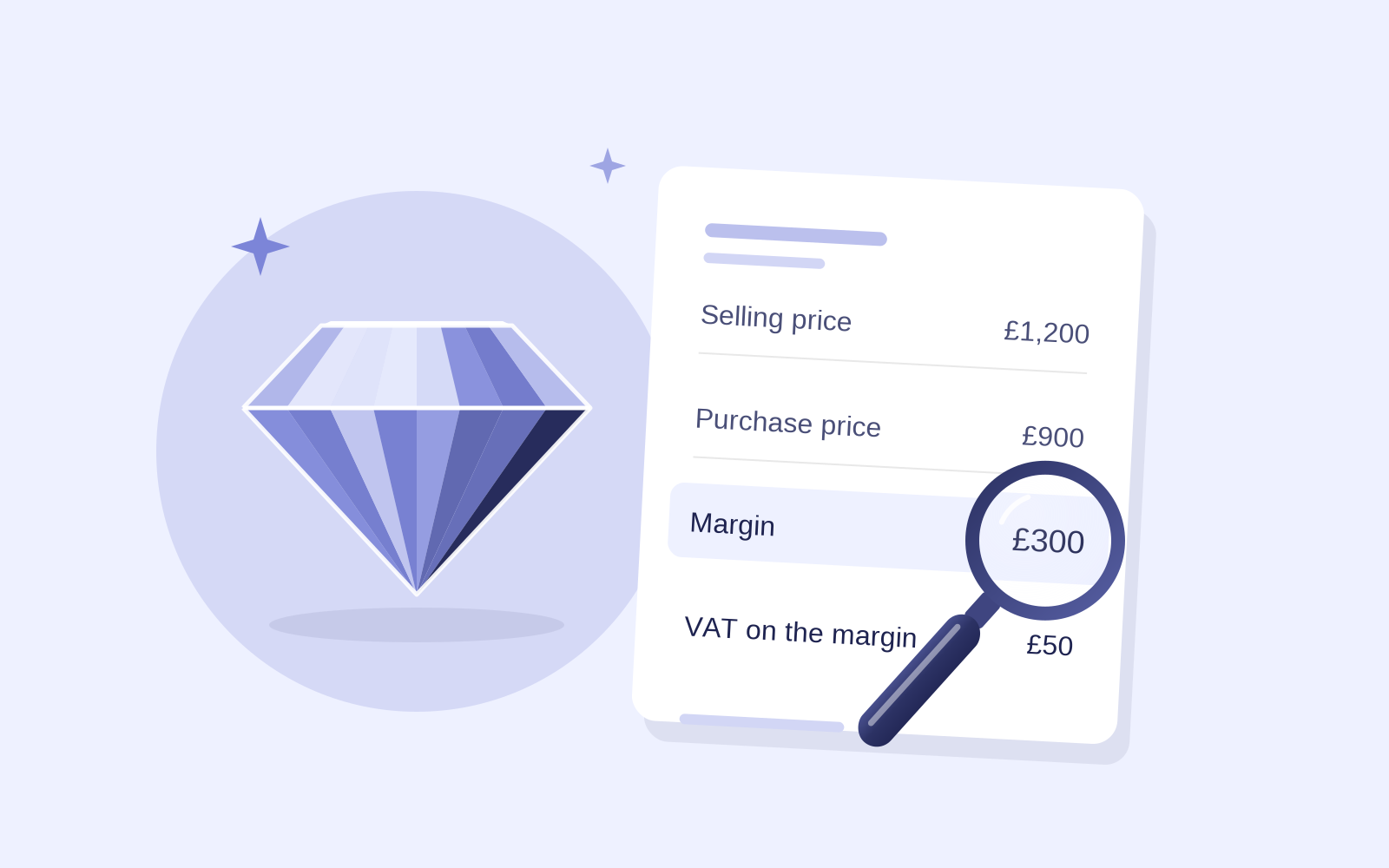
What is the VAT margin scheme, and can gem dealers use it?
Pay VAT on your margin instead of the full price, but loose diamonds, rubies, sapphires and emeralds don’t qualify.
The short answer
- The VAT margin scheme is an optional HMRC scheme under which a VAT-registered business pays VAT on its margin, the selling price minus the purchase price, rather than on the full selling price; at the 20% standard rate the VAT is one-sixth of the margin.
- HMRC’s margin scheme guidance says loose diamonds, rubies, sapphires and emeralds that are not mounted, set or strung are not eligible for the VAT margin scheme, whatever their age.
- The VAT margin scheme only applies to goods on which the dealer was not charged VAT, usually bought from a private individual, an unregistered business or another dealer selling under the margin scheme.
- Costs such as repairs and improvements cannot be added to the purchase price under the VAT margin scheme, though VAT charged on them can be reclaimed in the normal way.
- Using the VAT margin scheme means keeping a stock book with a stock number for every item and putting the right margin scheme wording on invoices; if the records are missing, HMRC says VAT is due on the full selling price.
Please read this as general information. See the note at the end.
The VAT margin scheme lets a VAT-registered business pay VAT on its margin instead of on the whole selling price. For gem dealers there is a catch: HMRC excludes loose diamonds, rubies, sapphires and emeralds. Where the scheme helps is with second-hand jewellery and other eligible goods bought without VAT, usually from private sellers. This guide sets out how the scheme works, what qualifies and the records it needs, all from HMRC’s own guidance.
HMRC rewrote that guidance this month. On 2 November 2026 it replaced VAT Notice 718 with a set of separate pages, and links to the old notice now lead there. HMRC hasn’t said any rule changed, but if you, or your accountant, worked from Notice 718, the wording has moved.
How does the VAT margin scheme work?
Under the margin scheme, VAT is charged on the difference between what you paid for an item and what you sold it for. HMRC’s overview says you pay VAT at 16.67%, one-sixth, on that difference. The scheme is optional, and you don’t register for it: you start using it by keeping the right records.
HMRC’s guide to working out the margin gives the method. Take the purchase price away from the selling price to get the margin, then multiply the margin by the VAT fraction, which is 1/6 for goods at the 20% standard rate. HMRC is clear that this is the margin on the item, not your overall profit.
Here is an example we’ve made up to show the sums: a second-hand ring bought from a private seller for £1,200 and sold for £1,800.
| Margin scheme | Normal VAT rules | |
|---|---|---|
| Selling price (including VAT) | £1,800 | £1,800 |
| Purchase price | £1,200 | £1,200 |
| Margin | £600 | not used |
| VAT due | £600 × 1/6 = £100 | £1,800 × 1/6 = £300 |
| Left after VAT | £1,700 | £1,500 |
On the same selling price, the dealer keeps £200 more under the margin scheme. That is why the scheme matters to anyone who buys from the public.
If you sell an item for the same as, or less than, you paid, there is no margin and no VAT is due. HMRC’s recording guidance says to show the margin and the VAT as nil in your stock book. You can’t set that loss against the margin on other items.
Which goods can go through the VAT margin scheme?
According to HMRC’s page on eligible goods, you can choose to use a margin scheme for second-hand goods, works of art, antiques and collectors’ items, excluding investment gold coins. HMRC defines them like this:
- Second-hand goods are goods that can still be used, or could be used after repair.
- Antiques are goods over 100 years old.
- Collectors’ items are stamps, coins and currency, and other pieces of scientific, historical or archaeological interest. HMRC adds that not everything people collect is eligible.
For more detail on collectors’ items, the eligibility page points to HMRC’s import valuation guidance. That page lists collectors’ pieces of mineralogical interest, among others, under customs heading 9705. The margin scheme pages themselves don’t mention mineral specimens, so if you sell them, ask your accountant how this applies to your stock.
Jewellery isn’t mentioned by name on the new pages. A second-hand piece of jewellery would come in as second-hand goods, or as an antique if it is over 100 years old, provided it was bought without VAT.
Can I use the VAT margin scheme for loose stones?
Not for the four main precious stones. HMRC’s list of goods that are not eligible includes:
Precious stones of any age which are not mounted, set or strung. For the purposes of the margin schemes, precious stones are diamonds, rubies, sapphires and emeralds.
So a loose diamond, ruby, sapphire or emerald is sold under the normal VAT rules, however old it is and whoever you bought it from. The same stone set in a ring, or a strung necklace, isn’t caught by that exclusion. HMRC’s shorter overview simply lists “precious stones” among the things you can’t use the scheme for, without the detail. The fuller eligibility page is the one to go by.
Other coloured stones are less clear. HMRC names only those four, so a loose spinel, tourmaline or garnet isn’t excluded by that rule. But HMRC doesn’t say whether a loose stone of that kind counts as second-hand goods. We couldn’t find an answer in the guidance, so this is a question for your accountant.
Precious metal has its own rule. HMRC says you can’t use the scheme where the selling price, excluding VAT, is no more than the open market value of the metal in the goods. A gold ring sold for its scrap value goes through the normal VAT rules.
Does it matter who I bought the stone or piece from?
Yes. HMRC says goods are usually only eligible if you were not charged VAT when you bought them. The common cases, from the eligibility page, are goods bought from:
- a private individual
- a business that isn’t VAT-registered and doesn’t charge you VAT
- another business selling to you under a margin scheme
If VAT is shown separately on your purchase invoice, the item can’t go through the margin scheme, even if you haven’t reclaimed that VAT. Most stock bought from a VAT-registered supplier or cutter will therefore be outside the scheme. A sole trader can move an eligible item from their own private collection into the business and use the scheme, as long as they have evidence of what they paid.
Imports are mostly outside it too. HMRC says goods imported from outside the UK are not normally eligible, apart from works of art, antiques and collectors’ items under special rules.
Can I add recutting or repair costs to the purchase price?
No. HMRC’s eligibility page says costs to repair or improve margin scheme goods can’t be included, and the purchase price shouldn’t be adjusted. You can reclaim any VAT you were charged on them in the normal way. HMRC doesn’t mention recutting or lab reports by name, so check with your accountant how they treat those for your business.
This is different from how you work out your own cost price for pricing. For your margin, you add every cost that belongs to the stone. For the margin scheme’s VAT sum, only the price you paid the seller counts.
What records does the VAT margin scheme need?
The scheme rests on records, and HMRC says that if you don’t meet all its requirements you pay VAT on the full selling price. The record-keeping rules are set out in HMRC’s keeping records page and the legal text.
A stock book, on paper or on a computer, with each item given a unique stock number in sequence:
| When you buy | When you sell |
|---|---|
| Stock number | Date of sale |
| Date of purchase | Sales invoice number |
| Purchase invoice number | Name of buyer |
| Name of seller | Description of the item |
| Description of the item | Selling price, or how it was disposed of |
| Purchase price | Margin, and the VAT due on it |
The stock number has to appear on both the purchase invoice and the sales invoice, so each item can be followed from one to the other.
A purchase invoice. If you buy from a private individual or an unregistered business, you make out the invoice yourself, with the seller’s name and address, your VAT number, the stock number, a description and the total price paid. You mustn’t add any other costs to that price.
A sales invoice with the stock number, a description and the total price. You must not show VAT separately. It must also carry one of HMRC’s phrases: “margin scheme - second hand goods”, “margin scheme - works of art” or “margin scheme - collectors’ items and antiques”. A dealer who buys from you under the scheme needs that wording to use the scheme in turn.
Memo goods. The legal text has a section on goods sent or received on sale or return, which is how most memo works. For goods sent to you, record the date they were transferred, a description, who sent them, and the date of return or the date you adopted, meaning bought, them. For goods you send out, record the same the other way round, including the date the other dealer adopted them.
HMRC says to keep VAT records for six years, and for stock you plan to sell under the scheme, until the item is sold if that is later.
What about global accounting, exports and Northern Ireland?
Global accounting is a version of the scheme where VAT is worked out on total eligible purchases and sales for each period, rather than item by item. HMRC’s global accounting page says it is for low-value goods bought and sold in bulk, and that you can’t use it for any item with a purchase value over £500. Most single stones and pieces of fine jewellery are likely to be over that.
Exports. Since 1 May 2023, margin scheme goods sold for export no longer have the margin zero-rated, according to HMRC’s exports page. VAT is due on the margin. You can still sell the item outside the scheme and use the normal export rules.
Northern Ireland has its own rules. HMRC says second-hand goods bought in Great Britain are not normally eligible to be resold in Northern Ireland under the scheme, except works of art, antiques and collectors’ items.
Do I have to be VAT-registered?
The margin scheme only matters if you’re VAT-registered. Registration becomes compulsory when your taxable turnover for the last 12 months goes over £90,000, or you expect it to in the next 30 days, according to GOV.UK. A dealer under the threshold who isn’t registered charges no VAT at all.
Questions to take to your accountant
- Which of my stock can go through the margin scheme: loose stones other than diamond, ruby, sapphire and emerald, set pieces, mineral specimens?
- How should I treat recutting, repairs, lab reports and valuations?
- Is my stock book good enough for HMRC, and does my invoice wording match theirs?
- How should I handle a piece bought on the margin scheme and sold for export, or into Northern Ireland?
- Is it worth using the scheme at all for the small share of my stock it covers?
We covered HMRC’s new margin scheme pages briefly in our November round-up.
Questions people ask
Can I use the VAT margin scheme for loose sapphires?
No. HMRC’s guidance lists precious stones of any age that are not mounted, set or strung as not eligible, and defines precious stones for the margin schemes as diamonds, rubies, sapphires and emeralds. A loose sapphire is sold under the normal VAT rules.
Can I use the VAT margin scheme for second-hand jewellery?
Often, yes. Second-hand goods are eligible if you were not charged VAT when you bought them, for example from a private seller. HMRC does not let you use the scheme where the selling price is no more than the open market value of the precious metal in the piece.
What about loose spinel, tourmaline or garnet?
HMRC’s exclusion names only diamonds, rubies, sapphires and emeralds, so other loose coloured stones are not caught by it. HMRC doesn’t say whether a loose spinel or tourmaline counts as second-hand goods, so this is one to take to your accountant before you rely on it.
Can I add the cost of a recut or a lab report to the purchase price?
No. HMRC says costs to repair or improve margin scheme goods cannot be included and the purchase price should not be adjusted. You can reclaim any VAT you were charged on those costs in the normal way.
Do I have to register to use the VAT margin scheme?
No. HMRC says you can start using a margin scheme at any time by keeping the correct records, and you do not have to register for it. You do have to be VAT-registered for the scheme to matter, which is compulsory once your taxable turnover goes over £90,000 in a 12-month period.
Is VAT due if I sell a margin scheme item at a loss?
No. If the selling price is the same as or lower than the purchase price there is no margin, so no VAT is due, and you show the margin and VAT as nil in your stock book. Under the standard scheme you can’t set that loss against the margin on other items.
Sources
- GOV.UK: How to account for VAT using the VAT margin scheme
- GOV.UK: VAT margin schemes
- GOV.UK: How to work out the margin and VAT due using VAT margin schemes
- GOV.UK: Goods eligible for the VAT margin scheme
- GOV.UK: How to value goods for import VAT
- GOV.UK: VAT margin schemes, keeping records
- GOV.UK: VAT tertiary legislation, margin schemes
- GOV.UK: Recording VAT margin scheme transactions
- GOV.UK: Using the global accounting VAT margin scheme
- GOV.UK: Exporting goods using the VAT margin scheme
- GOV.UK: Buying and selling goods in Northern Ireland using the VAT margin scheme
- GOV.UK: When to register for VAT
Sources were checked on 27 November 2026.